
Work with Merlin
Merlin plans and delivers retained communications and reputation programmes. Campaigns are built around your objectives and delivered through Merlin’s agentic infrastructure.
Merlin builds communications and reputation programmes on agentic infrastructure. Specialist agents share brand knowledge, campaign objectives and evidence across research, planning, content and monitoring. Communications experts guide the work, and your team approves strategy and external communications.
Merlin builds campaigns and workflows on agentic infrastructure. Specialist AI agents connect research, planning, content and monitoring around your objectives.
The agents share knowledge of your brand, audiences and campaigns. Evidence and approved decisions carry forward between tasks, reducing repeated preparation and keeping the work connected.
Communications experts guide the work. Your team approves strategy and external communications. Reviewed results update shared knowledge and inform improvements to workflows and future campaigns.
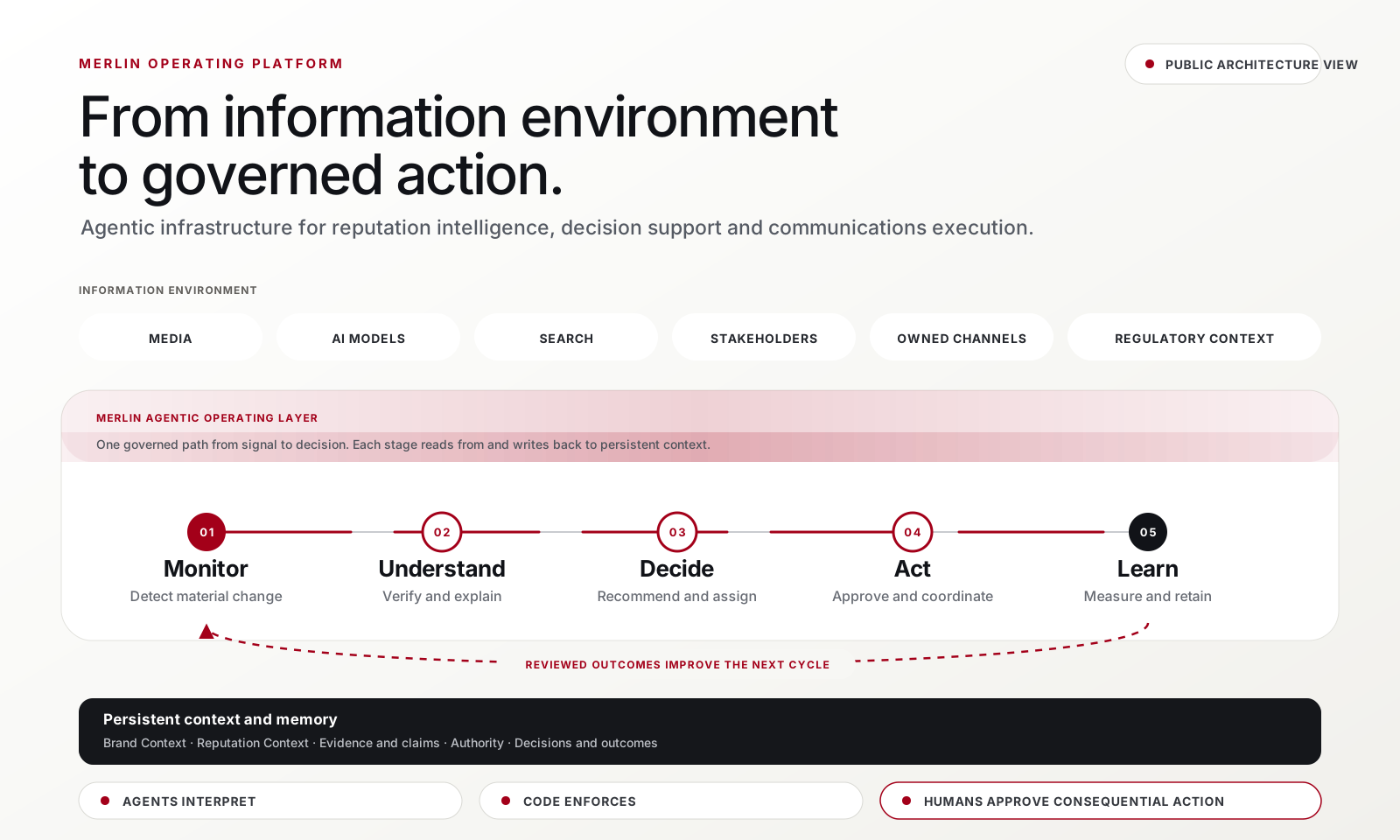
Information environment
Media · AI models · Search · Stakeholders · Owned channels
Detect material change
Verify and explain
Recommend and assign
Approve and coordinate
Measure and retain
↺ Reviewed outcomes improve the next cycle
Brand Context · Reputation Context · Evidence and claims · Authority · Decisions and outcomes
Agents interpret.
Code enforces.
Humans approve consequential action.
Merlin’s connected specialist agents share context and pass work forward using agreed sources, permissions and approval rules.
Research agents identify and verify a relevant market development.
Payment delays hold back small businesses
Source identifiedStrategy agents connect the signal to your objective, product and campaign.
Your team approves the angleMedia agents check relevant journalists, recent coverage and media records.
Payments reporterRecent coverage
Business editorRelevant beat
Content agents prepare talking points, a brief, draft release and outreach email.
Your team refines the recommendation, approves outreach and agrees next steps.
Human approval before releaseOutreach pack
Ready for reviewAfter approved outreach, monitoring connects coverage and stakeholder responses to the campaign objective.
Track the response
Your team reviews results and corrections. Useful evidence updates shared knowledge and informs the next campaign.
Carry useful knowledge forward
Brand · Campaign · Evidence · Reviewed decisions
Keep priorities, approved messages and useful evidence close to the work.
See the evidence behind a recommendation. Question its assumptions. Choose what happens next.
Agents interpret. Code enforces. Humans approve consequential action.
Agree permissions, approval routes, information access and retention before work begins. Validate the controls for your scope during procurement; no security certification or compliance guarantee is claimed.
Merlin plans and delivers retained communications and reputation programmes. Campaigns are built around your objectives and delivered through Merlin’s agentic infrastructure.
Build intelligence capabilities and agentic workflows around how your team works. Merlin connects research, planning, content and monitoring to automate repetitive tasks and increase your team’s capacity to deliver campaigns.
Learn to build and deploy agentic workflows. Merlin trains communications, PR and marketing teams to apply AI to research, planning, content and monitoring.
Shared context, specialist agents and human decisions connect every campaign. Explore the six layers that support the work.
Media, search, AI models, stakeholder and owned-channel signals.
Brand Context, Reputation Context, approved claims and evidence.
Narrative analysis, audience interpretation and materiality.
Objectives, scenarios, recommendations and response options.
Permissions, human approvals, communications activity and escalation.
Outcomes, attribution, retained context and controlled updates.
Discuss retained campaigns, dedicated workflows or training for your team.
Book a call